Published on Sunday, August 20, 2006 by the Guardian / UK
Uri, My Dear Son
As the Lebanon war raged, David Grossman, the celebrated Israeli writer, publicly urged his government to accept a ceasefire. Just days later, his soldier son was killed by one of Hizbollah's final anti-tank missiles. This is the eulogy he read at the funeral
by David Grossman
At 20 to three in the morning, between Saturday and Sunday, the doorbell rang. Over the intercom, they said they were from the army. For three days, every thought begins with: 'He/we won't.'
He won't come. We won't talk. We won't laugh. He won't be that kid with the ironic look in his eyes and the amazing sense of humour. He won't be that young person with understanding deeper than his years. There won't be that warm smile and healthy appetite. There won't be that rare combination of determination and gentleness. There won't be his common sense and wisdom. We won't sit down together to watch The Simpsons and Seinfeld, and we won't listen to Johnny Cash, and we won't feel the strong embrace. We won't see you going to talk to your brother, Yonatan, with excited hand movements and we won't see you hugging your sister, Ruthie, the love of your life.
Uri, my love. All your short life, we have all learned from you, from the strength and determination to go your own way. To go your own way even if there is no way you could succeed. We followed with amazement your struggle to get into the tank commanders' course. How you never compromised with your commanders, because you knew you would be a great commander. You were not satisfied to give less than you thought you could. And when you succeeded, I thought here's a man who knows his own abilities in such a simple and wise way. Here's a man who has no pretensions or arrogance, who isn't influenced by what others say about him, whose source of strength is internal.
From childhood, you were like that. A child who live in harmony with himself and those around him. A child who knew his place, and knew that he was loved, who recognised his limitations and strengths. And truly, from the moment you forced the army to make you a commander, it was clear what kind of commander and person you were. We hear today from your comrades and your subordinates about the commander and friend. About the person who got up before everyone else in order to organise everything and who went to sleep only after everyone else had. And yesterday, at midnight, I looked at our house which was quite a mess after the visits of hundreds of people who came to console us and I said to myself: 'Well, now we need Uri, to help us organise it again.'
You were the leftie of your battalion and you were respected for it, because you stood your ground, without giving up even one of your military assignments ...
You were a son and a friend to me and to Mummy. Our soul is tied to yours. You felt good in yourself and you were a good person to live with. I cannot even say out loud how much you were 'Someone to Run With'. Every furlough you would say: 'Dad, let's talk' and we would go, usually to a restaurant, and talk. You told me so much, Uri, and I felt proud that I was your confidante.
I won't say anything now about the war you were killed in. We, our family, have already lost in this war. The state of Israel will have its own reckoning ...
Uri was such an Israeli child; even his name was very Israeli and Hebrew. He was the essence of Israeli-ness as I would want it to be. An Israeli-ness that has almost been forgotten, that is something of a curiosity. And he was a person so full of values. That word has been so eroded and has become ridiculed in recent years. In our crazy, cruel and cynical world, it's not 'cool' to have values, or to be a humanist, or to be truly sensitive to the suffering of the other, even if that other is your enemy on the battlefield.
However, I learned from Uri that it is both possible and necessary to be all that. We have to guard ourselves, by defending ourselves both physically and morally. We have to guard ourselves from might and simplistic thinking, from the corruption that is in cynicism, from the pollution of the heart and the ill-treatment of humans, which are the biggest curse of those living in a disastrous region like ours. Uri simply had the courage to be himself, always and in all situations - to find his exact voice in every thing he said and did. That's what guarded him from the pollution and corruption and the diminishing of the soul.
'In the night between Saturday and Sunday, at 20 to three in the morning, our doorbell rang. The person said through the intercom that he was from the army, and I went down to open the door, and I thought to myself - that's it, life's over. But five hours later, when Michal and I went into Ruthie's room to wake her and tell her the terrible news, Ruthie, after first crying, said: 'But we will live, right? We will live and trek like before and I want to continue singing in a choir, and we will continue to laugh like always and I want to learn to play guitar.' And we hugged her and told her that we will live.'
We will derive our strength from Uri; he had enough for many years to come. Vitality, warmth and love radiated from him strongly, and that will shine on us even if the star that made it has been extinguished. Our love, we had a great honour to live with you. Thank you for every moment that you were ours.
Father and Mother, Yonatan and Ruthie.
Translated from the original Hebrew by Joseph Millis, world news editor of the Jewish Chronicle
Monday, August 21, 2006

Thursday, August 17, 2006
This obsession with the "War on Terror"
This article brings up several good points about how this relatively new obsession with the "War on Terror" is not really getting us anywhere, if anything, it is making it worse for us. Ever since this 'war' started people have never felt more frightened and unsecure. I think it's about time we start turning to new ways to solve this problem because all I see heading our way is more hate and more violence.
Published on Tuesday, August 15, 2006 by the Wall Street Journal
A Self-Defeating War
by George Soros
The war on terror is a false metaphor that has led to counterproductive and self-defeating policies. Five years after 9/11, a misleading figure of speech applied literally has unleashed a real war fought on several fronts -- Iraq, Gaza, Lebanon, Afghanistan, Somalia -- a war that has killed thousands of innocent civilians and enraged millions around the world. Yet al Qaeda has not been subdued; a plot that could have claimed more victims than 9/11 has just been foiled by the vigilance of British intelligence.
Unfortunately, the "war on terror" metaphor was uncritically accepted by the American public as the obvious response to 9/11. It is now widely admitted that the invasion of
What makes the war on terror self-defeating?
- First, war by its very nature creates innocent victims. A war waged against terrorists is even more likely to claim innocent victims because terrorists tend to keep their whereabouts hidden. The deaths, injuries and humiliation of civilians generate rage and resentment among their families and communities that in turn serves to build support for terrorists.
- Second, terrorism is an abstraction. It lumps together all political movements that use terrorist tactics. Al Qaeda, Hamas, Hezbollah, the Sunni insurrection and the Mahdi army in
- Third, the war on terror emphasizes military action while most territorial conflicts require political solutions. And, as the British have shown, al Qaeda is best dealt with by good intelligence. The war on terror increases the terrorist threat and makes the task of the intelligence agencies more difficult. Osama bin Laden and Ayman al-Zawahiri are still at large; we need to focus on finding them, and preventing attacks like the one foiled in
- Fourth, the war on terror drives a wedge between "us" and "them." We are innocent victims. They are perpetrators. But we fail to notice that we also become perpetrators in the process; the rest of the world, however, does notice. That is how such a wide gap has arisen between
Taken together, these four factors ensure that the war on terror cannot be won. An endless war waged against an unseen enemy is doing great damage to our power and prestige abroad and to our open society at home. It has led to a dangerous extension of executive powers; it has tarnished our adherence to universal human rights; it has inhibited the critical process that is at the heart of an open society; and it has cost a lot of money. Most importantly, it has diverted attention from other urgent tasks that require American leadership, such as finishing the job we so correctly began in
With American influence at low ebb, the world is in danger of sliding into a vicious circle of escalating violence. We can escape it only if we Americans repudiate the war on terror as a false metaphor. If we persevere on the wrong course, the situation will continue to deteriorate. It is not our will that is being tested, but our understanding of reality. It is painful to admit that our current predicaments are brought about by our own misconceptions. However, not admitting it is bound to prove even more painful in the long run. The strength of an open society lies in its ability to recognize and correct its mistakes. This is the test that confronts us.
Mr. Soros, a financier, is author of "The Age of Fallibility: Consequences of the War on Terror" (Public Affairs, 2006).
Tuesday, August 15, 2006
What international peace groups in Lebanon have to say
The Daily Star
Tuesday, August 15, 2006
Peace group voices solidarity with Lebanon
By Iman Azzi
Special to The Daily Star
"We are here in
Since arriving in
"The victory of the Lebanese resistance over
"The courageous Lebanese national resistance led by Hizbullah and its secretary general, [Sayyed] Hassan Nasrallah, has led to this historic victory," the statement added.
Seema Mustafa, resident editor of Asian Age, spoke about her disappointment of the media coverage within
"I'm here to condemn the role of the media. The kind of material that is being made available - especially by AP, AFP and Reuters - is only making one particular point, adding to the disinformation which is creating myths and projecting the Arab world as almost barbarians," said Mustafa, who covered the 1982 Israeli invasion of Lebanon.
Kjeld Jakobsen, chair of the Social Observatory Institute, a think tank on multinationals and labor standards, said he was representing
"I want to be a personal witness to tell my country the things that don't appear in the international media," Jakobsen said.
"As a peace activist I really had no choice but to come here," said Kamal Chenoy, a member of the All India Peace and Solidarity Organization. "Israelis have been attacking their neighbors on the grounds of defending the Jewish state. I was brought up a Jew and I came to tell them this is not an attack by Jews but by Zionists and fascists."
When asked about UN Security Council Resolution 1701 and the prospects for the cease fire that officially began Monday, Chenoy remarked: "I have serious reservations about this resolution. It is a one-sided kind of document and [the] Israelis always interpret resolutions as they want."
The delegation agreed that a long-term peace agreement between
The delegation also called on the
Friday, August 11, 2006
Why the first UN Resolution proposal failed....
Here is a piece which came out from the Institute of Policy studies analyzing why the proposed UN resolution failed the first time around. According to this and several other reports that I read, it was trying to pass a very baised and unilaterally agreed resolution.
Here is a link to the report:
http://www.ips-dc.org/comment/bennis/tp44lebanon-un.htm
Here is a link to the report:
http://www.ips-dc.org/comment/bennis/tp44lebanon-un.htm
Non-violent march TOMORROW- Saturday August 12, 2006 at 12pm
A non-violent march will be held tomorrow to protest the ongoing war. People in all parts of the world will be protesting on this same day, SATURDAY AUGUST 12, 2006. There will be several speakers deploring the destruction of lives and asking for an immediate ceasefire. People will be meeting in Lafayette Park in front of the White House.
Wednesday, August 09, 2006
Use of Cluster Bombs: Yet Another International Law and Human Rights Violation
Published on Wednesday, August 9, 2006 by the
Cluster Attacks and International Law
by César Chelala
What makes those munitions particularly lethal is that they consist of a container that breaks open in mid air and disperses smaller sub-munitions. Those weapons are designed to explode on impact, right before and immediately after impact, saturating an area with flying shards of steel. These sub-munitions generally have a higher explosive charge than anti-personnel land mines.
The failure rate for cluster weapons is between 5 percent and 30 percent. Failure to explode on impact doesn't mean they are harmless. On the contrary, they may explode with the slightest touch by a child or an innocent passerby. What makes them even more dangerous is that they become more unstable with each passing year, according to bomb-disposal experts working in
Human Rights Watch said it has not found any evidence that Hezbollah is using cluster munitions.
Currently, no treaty specifically regulates cluster munitions. However, Additional Protocol I of 1977 to the Geneva Conventions has some internationally accepted legal standards to assess the problems caused by those weapons. Although that protocol recognizes the inevitability of some civilian deaths, it also says states cannot legally target civilians or engage in indiscriminate attacks.
Cluster munitions have the potential to be indiscriminate because they cannot be precisely targeted. In that regard, Article 51 (4) (b) specifically prohibits attacks "which employ a method or means of combat which cannot be directed at a specific military objective." Kenneth Roth, executive director of Human Rights Watch, states, "Cluster munitions are unacceptably inaccurate and unreliable weapons when used around civilians, and should never be used in populated areas."
Lebanese security forces have denounced
Because of the high proportion of civilians killed or injured by those weapons, they are opposed by many organizations including the Red Cross, the Cluster Munition Coalition and the United Nations. There is now a growing international consensus to stop the use of those weapons.
In February 2006,
In a recent report titled "Fatal Strikes: Israel's Indiscriminate Attacks Against Civilians in Lebanon," Human Rights Watch states, "By consistently failing to distinguish between combatants and civilians, Israel has violated one of the most fundamental tenets of the laws of war: the duty to carry out attacks on only military targets ... the extent of the pattern and the seriousness of the consequences indicate the commission of war crimes."
In that context, the use of cluster munitions adds only a further note of desperation.
As a significant deterrent to what easily can become a regional war, Francis Boyle, a law professor at the
As Boyle says, "The establishment of the ICTI would provide some small degree of justice to the victims of Israeli war crimes, crimes against humanity and genocide against the peoples of
César Chelala is an international public health consultant and a winner of an Overseas Press Club of
[Added August 11,2006]
And as the International community stalls to find an end to the fighting, claiming that Israel will have about a month to pull out little by little while an international force is put in, here is the latest petition from Israel to the US: "The New York Times reported Washington was considering an Israeli request for M-26 artillery rockets with cluster munitions it wants to use against suspected Hizbullah missile sites. A senior
Funny how it is so quickly approved to have arms, but when it comes to taking some time to think out a fair and lasting peace deal, it takes so long!
Tuesday, August 08, 2006
Death comes to Ghaziyeh
I just found out about an hour ago that one of my roommate's best friends lost her parents in an Israeli attack on the small town of Ghaziyeh. She is also severely wounded- she is about 19 years old. As an attractive young girl who was pursuing a university education, her only crime was living in the south of Lebanon and having been born in a Shiite family. Why does everyone think that being Shiite means being a terrorist, or being a religious extremist? Aren't there some extremists in every religion? Why do people have to focus only on a minority and have it represent the whole group? I suppose this is the only way to create an enemy. This is the only way to demonize people and make you and your people feel threatened and feel like there is a reason to get rid of the enemy. But don't people realize that this way of thinking only makes a self-fulfilling prophecy? Don't they see it eventually just creates more extremism as it, in return, then threatens the 'created enemy'?
She has one older sister living closer to Beirut who has two daughters. Now, both sisters are orphans. At least they are lucky to be old enough to take care of themselves. What about the hundreds of children out there who aren't as lucky, what are they to become? If this young girl survives, how will she ever continue her education- or her life? She has nothing left!! I don't know what to think at this point. Really, I feel as though the world has lost all sense of humanity. Countries have to stop acting like businesses and they need to start being a little more compassionate when they lead. They need to put a little more reason when they make decisions. They need to listen more, and investigate more- find out WHY things are the way they are, not just start labeling without truly understanding. And I mean this for all sides of the issue..... Sometimes I tell this to people who then tell me that we are living in a realist world after all and it's naive to think that people will be compassionate or that peaceful means are better than using force. But who is creating the world we live in? Aren't we? Hasn't the realist view just brought us wars and hatred so far? I think it's about time we think it over and start to make changes. We can't continue to be blind to the fact that we are all interconnected- events don't happen in a vacuum. 'Every action has an equal or opposite reaction', it's like a domino effect almost. We can just see it from looking at the history of all the people involved in this situation.
For now, I can only pray. Pray for all those in this conflict who have lost everything they have, pray for all those who are psychologically tormented and pray for those who have lost faith in the world. Hope, knowledge, and love are my only defense....
She has one older sister living closer to Beirut who has two daughters. Now, both sisters are orphans. At least they are lucky to be old enough to take care of themselves. What about the hundreds of children out there who aren't as lucky, what are they to become? If this young girl survives, how will she ever continue her education- or her life? She has nothing left!! I don't know what to think at this point. Really, I feel as though the world has lost all sense of humanity. Countries have to stop acting like businesses and they need to start being a little more compassionate when they lead. They need to put a little more reason when they make decisions. They need to listen more, and investigate more- find out WHY things are the way they are, not just start labeling without truly understanding. And I mean this for all sides of the issue..... Sometimes I tell this to people who then tell me that we are living in a realist world after all and it's naive to think that people will be compassionate or that peaceful means are better than using force. But who is creating the world we live in? Aren't we? Hasn't the realist view just brought us wars and hatred so far? I think it's about time we think it over and start to make changes. We can't continue to be blind to the fact that we are all interconnected- events don't happen in a vacuum. 'Every action has an equal or opposite reaction', it's like a domino effect almost. We can just see it from looking at the history of all the people involved in this situation.
For now, I can only pray. Pray for all those in this conflict who have lost everything they have, pray for all those who are psychologically tormented and pray for those who have lost faith in the world. Hope, knowledge, and love are my only defense....
Saturday, August 05, 2006
Peace Vigil Sunday Evening, August 6, 2006
A silent vigil will be held tomorrow from 8pm to 10pm in protest of the attacks on Lebanon and in a one-week commemoration of the Qana Massacre.
Organizers include:
The Lebanese American Community of the Washington Metropolitan Area
In association with
Arab American Associations and
Human Rights Activists
Organizers include:
The Lebanese American Community of the Washington Metropolitan Area
In association with
Arab American Associations and
Human Rights Activists
The world is speaking, but who is listening?
India:
Here is what some street children in India, who have been through war, have to say:
Street kids' plea to end W. Asia war
Staff Reporter, The Hindu
NEW DELHI: Registering their distress at the plight of children in Lebanon and West Asia, street children and working children here in the Capital held an emergency meeting on Tuesday to express their concern. The meeting saw the participation of 50 street and working children under the banner of non-government organisations Badthe Kadam and Childhood Enhancement through Training and Action.
They appealed to the leaders of Israel and Lebanon to find a solution to the problem through talks. A `Memorandum of Peace and Brotherhood' will be sent to the Israel embassy on behalf of the children of Badthe Kadam.
Expressing her concern over the large number of children becoming homeless due to the aggression, 14-year-old Nek Muhammed, a balloon vendor, said: "I am worried about the children who have become homeless, like us, due to the war."
"Wars should be banned everywhere. No child should suffer whether he or she is from Israel, Lebanon or India. Wars only spread hatred. Both countries should sit together and find a solution to this problem. Leaders must understand that there are no winners in war," said 16-year-old Suresh who works as a rag picker at Yusuf Sarai in South Delhi.
The Badthe Kadam secretary, 19-year-old Subhash, also expressed his grief over the death of such a large number of children.
He said through this meeting he wanted to appeal to the Indian Government to come forward and intervene in an effective manner so that the war can be stopped and the rights of children along with the rights of every common citizen could be protected and restored.
Egypt:
Egyptian officials, artists bring aid and a message of solidarity
The Daily Star
Here is what some street children in India, who have been through war, have to say:
Street kids' plea to end W. Asia war
Staff Reporter, The Hindu
NEW DELHI: Registering their distress at the plight of children in Lebanon and West Asia, street children and working children here in the Capital held an emergency meeting on Tuesday to express their concern. The meeting saw the participation of 50 street and working children under the banner of non-government organisations Badthe Kadam and Childhood Enhancement through Training and Action.
They appealed to the leaders of Israel and Lebanon to find a solution to the problem through talks. A `Memorandum of Peace and Brotherhood' will be sent to the Israel embassy on behalf of the children of Badthe Kadam.
Expressing her concern over the large number of children becoming homeless due to the aggression, 14-year-old Nek Muhammed, a balloon vendor, said: "I am worried about the children who have become homeless, like us, due to the war."
"Wars should be banned everywhere. No child should suffer whether he or she is from Israel, Lebanon or India. Wars only spread hatred. Both countries should sit together and find a solution to this problem. Leaders must understand that there are no winners in war," said 16-year-old Suresh who works as a rag picker at Yusuf Sarai in South Delhi.
The Badthe Kadam secretary, 19-year-old Subhash, also expressed his grief over the death of such a large number of children.
He said through this meeting he wanted to appeal to the Indian Government to come forward and intervene in an effective manner so that the war can be stopped and the rights of children along with the rights of every common citizen could be protected and restored.
Egypt:
Egyptian officials, artists bring aid and a message of solidarity
The Daily Star
BEIRUT: An Egyptian military plane arrived in Beirut Tuesday morning carrying President Hosni Mubarak's son Gamal, relief aid and 70 officials and figures from the country's illustrious acting community who joined the trip to express their support for war-torn Lebanon.
Egypt's ministers of information, health, and industry and foreign trade - in addition to the leaders of several opposition parties and top actors - arrived to deliver medical supplies.
They also met with Lebanese President Emile Lahoud, Speaker Nabih Berri and Prime Minister Fouad Siniora and visited the wounded in hospitals before departing.
Siniora said that the delegation's visit enhances the support for Lebanon shown during the Arab League foreign ministers' meeting in Beirut Monday.
"We feel that your visit is a follow-up to the foreign ministers' visit. It expresses the unified Arab position to support Lebanon," Siniora said.
Gamal Mubarak is the head of the policy secretariat of the ruling National Democratic Party, and also heads a charitable foundation, but it was not clear in what capacity he joined Tuesday's relief flight.
Mubarak later told LBCI television the trip to Lebanon "reflected the Egyptian people's solidarity with the Lebanese people and government."
He also said he hoped the Arab delegation to the UN Security Council would be able to push through the proposed Lebanese amendments to the Franco-American draft resolution to end the Israeli offensive.
Another member of the delegation said Egyptians empathized with the Lebanese, having themselves faced Israel in several wars.
"The [Suez] Canal zone was destroyed several times and many of its people fled from Port Said, Ismailiyya and Suez," actor Hussein Fahmy told The Daily Star.
"We are standing by the Lebanese people and we will not leave them alone to face the Israeli attack. We support the heroic resistance that is defending the land," he added.
Egypt and Jordan are the only two Arab countries permitted by Israel to land relief flights at Beirut's Rafik Hariri International Airport.
Israel:
First-hand account taken from an Israeli blogger-
"And lo, there were people there. Many people, in fact. Okay, so they were mostly from the so-called far left: Gush Shalom, Hadash, Yesh Gvul were the most visible, but there were other groups as well. But no, they were not all artsy fartsy bleeding heart liberal Ashkenazim. There were Arabs and Jews, Ashkenazim and Mizrahim, teenagers, young couples with children and old people." [............]
"And yes, I did see the ultimate ineffectiveness of this demonstration. But
really, it was rather heartwarming. Some sincere, goodhearted people stood up while their country was under siege and got together to say publicly that they hate killing, but they don't hate the people who live in the country from which missiles are launched at them."
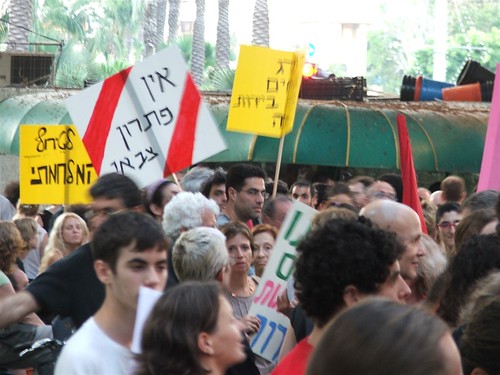

"There is no military solution" (Picture 1) "In war there are only losers" (Picutre 2)
England:
"On Sunday, a crowd of 20,000 organized by the Stop the War Coalition marched through London to demand an end to the Israeli offensive." The Daily Star
There have been many more protests around the world in Turkey, Dubai, Australia, Canada, Greece, France, Germany, Russia, Pakistan, Bangladesh, Kenya, Italy, Spain, Brazil and the list goes on. I had posted pictures of protests in some of these countries, but it was making my blog freeze up so I had to take them down.
Article written by an Jewish-American lady
Published on Friday, August 4, 2006 by the Long Island, New York, Newsday
"Why Doesn't Israel Work For Peace?"
Holocaust victims would decry the slaughter of innocent children during attacks on Hezbollah
by Silvia Tennenbaum
As a Jew who escaped the Holocaust by moving with my family to America in 1938, I turn on the BBC at night. And what I see are clouds of black smoke, explosions; the dead and the dying - children crying bitterly, cities in ruins. Only yesterday, these piles of rubble in Lebanon were home to thousands. Now, the cars roll out onto the highways, white flags attached to the windshields and doors. More than half a million are homeless.
The Israelis told them to leave, but then strafed one convoy from a helicopter. The military people exert their force without pity. They win their wars proudly. They are the masters of force.
Using the most modern weapons the United States can supply to search out the Hezbollah guerrillas, the Israeli soldiers destroy Lebanon. They wreck all of Gaza, seeking to murder the leaders of Hamas.
Many American Jews gather proudly to cheer them on. The face of the American president remains blank. A patter of platitudes issues from his lips. He is not interested in peace. He is happy to see Israel do the dirty war for him. Diplomacy is a word not in his dictionary.
But lo and behold - even as the destruction builds and the war continues through its third week - it seems suddenly no longer such a lark. Success is hard to come by; Israel is no longer the perennial victor. But will it know what to do when faced with the need to talk with the enemy? It has always felt so invincible that discussion seemed the weapon of fools and weaklings, much like the way the earnest work of its principled and dedicated peace camp - Jewish to the core, in an "old-fashioned" way - seemed pathetic and misguided.
But the peace camp knew that each and every Israeli atrocity nurtured another enemy, a potential terrorist, while every Palestinian home that the Israeli Committee Against House Demolitions helped to rebuild, every olive tree it planted tenderly in occupied soil, brought another possible friend, another partner in dialogue.
Meanwhile, back at the American Israel Public Affairs Committee, deep in the heart of the Jewish Lobby, the call to action is, as always, a call for solidarity, for good public relations. Denounce terrorism, suicide bombers and anti-Semitism in all its endless variations, which includes the "self-hatred" of the misguided Jew who asks us to give some thought to where we - obsessed with brutal retaliation - may have gone wrong.
And, it goes without saying, loyal Jews must talk about the Holocaust. Ignore the images of today's dead and dying, and focus on the grainy black-and-white pictures showing the death of Jews in the villages of Poland, at Auschwitz and Sobibor and Bergen-Belsen. We are the first, the only true victims, the champions of helplessness for all eternity.
No matter what great accomplishments were ours in the diaspora, no matter that we produced Maimonides and Spinoza, Moses Mendelssohn and hundreds of others of mankind's benefactors - not a warrior among them! - look at the world of our long exile always in the dark light of the Shoah. But this, in itself, is an obscene distortion: Would the author of "Survival in Auschwitz," Primo Levi, or the poet Paul Celan demand that we slaughter the innocents in a land far from the snow-clad forests of Poland? Is it a heroic act to murder a child, even the child of an enemy? Are my brethren glad of it and proud?
I am heartsick, and still I see a glimmer of hope (there must be that glimmer, to go on at 78 years).
The American peace camp reports a sudden massive increase in membership. All over the country, Jews whose consciences have not been crippled are writing in, speaking up, gathering, to raise their voices. Is this not what we have always done? What we were brought up to do? What - since the days of the Bible and the prophets - our forefathers taught us? If Israel had worked for peace as hard as it has worked for war, might it not all be settled now?
Three hundred British Jews took out an ad in the Times of London to ask the question, "What is Israel doing?" This question has now been taken up by Jewish Voice for Peace, and by Alan Sokal and Bruce Robbins who, some years back, placed an ad in The New York Times, that read, "Not in Our Name."
The time is long overdue for Jews to return to their role as the world's conscience, who come to the aid of the dispossessed, the wretched of the earth. Once again, we must join those who demand the end to unjust wars - in Iraq as well as Lebanon - and an unjust occupation in Gaza. We must honor the example of American civil rights workers Andrew Goodman and Michael Schwerner, not that of the mass murderer Baruch Goldstein or Yigal Amir, killer of Yitzhak Rabin.
And perhaps the day will come that we will be counted - by Jew and Arab alike - as among the Just, perhaps even given a place at Yad Vashem, the Holocaust memorial in Jerusalem, for the lives we helped to save in a lawless, savage time.
Silvia Tennenbaum, a writer in East Hampton, is author of the novels "Yesterday's Streets" and "Rachel, the Rabbi's Wife"
"Why Doesn't Israel Work For Peace?"
Holocaust victims would decry the slaughter of innocent children during attacks on Hezbollah
by Silvia Tennenbaum
As a Jew who escaped the Holocaust by moving with my family to America in 1938, I turn on the BBC at night. And what I see are clouds of black smoke, explosions; the dead and the dying - children crying bitterly, cities in ruins. Only yesterday, these piles of rubble in Lebanon were home to thousands. Now, the cars roll out onto the highways, white flags attached to the windshields and doors. More than half a million are homeless.
The Israelis told them to leave, but then strafed one convoy from a helicopter. The military people exert their force without pity. They win their wars proudly. They are the masters of force.
Using the most modern weapons the United States can supply to search out the Hezbollah guerrillas, the Israeli soldiers destroy Lebanon. They wreck all of Gaza, seeking to murder the leaders of Hamas.
Many American Jews gather proudly to cheer them on. The face of the American president remains blank. A patter of platitudes issues from his lips. He is not interested in peace. He is happy to see Israel do the dirty war for him. Diplomacy is a word not in his dictionary.
But lo and behold - even as the destruction builds and the war continues through its third week - it seems suddenly no longer such a lark. Success is hard to come by; Israel is no longer the perennial victor. But will it know what to do when faced with the need to talk with the enemy? It has always felt so invincible that discussion seemed the weapon of fools and weaklings, much like the way the earnest work of its principled and dedicated peace camp - Jewish to the core, in an "old-fashioned" way - seemed pathetic and misguided.
But the peace camp knew that each and every Israeli atrocity nurtured another enemy, a potential terrorist, while every Palestinian home that the Israeli Committee Against House Demolitions helped to rebuild, every olive tree it planted tenderly in occupied soil, brought another possible friend, another partner in dialogue.
Meanwhile, back at the American Israel Public Affairs Committee, deep in the heart of the Jewish Lobby, the call to action is, as always, a call for solidarity, for good public relations. Denounce terrorism, suicide bombers and anti-Semitism in all its endless variations, which includes the "self-hatred" of the misguided Jew who asks us to give some thought to where we - obsessed with brutal retaliation - may have gone wrong.
And, it goes without saying, loyal Jews must talk about the Holocaust. Ignore the images of today's dead and dying, and focus on the grainy black-and-white pictures showing the death of Jews in the villages of Poland, at Auschwitz and Sobibor and Bergen-Belsen. We are the first, the only true victims, the champions of helplessness for all eternity.
No matter what great accomplishments were ours in the diaspora, no matter that we produced Maimonides and Spinoza, Moses Mendelssohn and hundreds of others of mankind's benefactors - not a warrior among them! - look at the world of our long exile always in the dark light of the Shoah. But this, in itself, is an obscene distortion: Would the author of "Survival in Auschwitz," Primo Levi, or the poet Paul Celan demand that we slaughter the innocents in a land far from the snow-clad forests of Poland? Is it a heroic act to murder a child, even the child of an enemy? Are my brethren glad of it and proud?
I am heartsick, and still I see a glimmer of hope (there must be that glimmer, to go on at 78 years).
The American peace camp reports a sudden massive increase in membership. All over the country, Jews whose consciences have not been crippled are writing in, speaking up, gathering, to raise their voices. Is this not what we have always done? What we were brought up to do? What - since the days of the Bible and the prophets - our forefathers taught us? If Israel had worked for peace as hard as it has worked for war, might it not all be settled now?
Three hundred British Jews took out an ad in the Times of London to ask the question, "What is Israel doing?" This question has now been taken up by Jewish Voice for Peace, and by Alan Sokal and Bruce Robbins who, some years back, placed an ad in The New York Times, that read, "Not in Our Name."
The time is long overdue for Jews to return to their role as the world's conscience, who come to the aid of the dispossessed, the wretched of the earth. Once again, we must join those who demand the end to unjust wars - in Iraq as well as Lebanon - and an unjust occupation in Gaza. We must honor the example of American civil rights workers Andrew Goodman and Michael Schwerner, not that of the mass murderer Baruch Goldstein or Yigal Amir, killer of Yitzhak Rabin.
And perhaps the day will come that we will be counted - by Jew and Arab alike - as among the Just, perhaps even given a place at Yad Vashem, the Holocaust memorial in Jerusalem, for the lives we helped to save in a lawless, savage time.
Silvia Tennenbaum, a writer in East Hampton, is author of the novels "Yesterday's Streets" and "Rachel, the Rabbi's Wife"
Robert Fisk: A terrible thought occurs to me - that there will be another 9/11
Reporting from Beirut, here is another interesting article from Robert Fisk. By the way, I was reading this article to my father today when he told me that he knew the man Joseph Bassil, that is mentioned in the article. He was a childhood friend and classmate.
A terrible thought occurs to me - that there will be another 9/11
A terrible thought occurs to me - that there will be another 9/11
by Robert Fisk
Published: 05 August 2006
The independent
The room shook. Not since the 1983 earthquake has my apartment rocked from side to side. That was the force of the Israeli explosions in the southern suburbs of
Is it to be like this every day? How many civilians can you make homeless before you start a revolution? And what is next? Are the Israelis to bomb the centre of
Yesterday, needless to say, was another day of massacres, great and small. The largest appeared to be 40 farm workers in northern
In
One of them was Joseph Bassil, 65, a Christian man who had gone out on his daily jogging exercise with four friends north of Jounieh. "His friends packed up after four rounds of the bridge because it was hot," a member of his family told us later. "Joseph decided to do one more jog on the bridge. That was what killed him." The Israelis gave no reason for the attacks - no Hizbollah fighters would ever enter this Christian Maronite stronghold and the only hindrance was caused to humanitarian convoys - and there were growing fears in
Indeed, as the
Does the
What in the meanwhile is happening to
So fierce has been Hizbollah's resistance - and so determined its attacks on Israeli ground troops in Lebanon - that many people here no longer recall that it was Hizbollah which provoked this latest war by crossing the border on 12 July, killing three Israeli soldiers and capturing two others.
And do the Israelis realise that they are legitimising Hizbollah, that a rag-tag army of guerrillas is winning its spurs against an Israeli army and air force whose targets - if intended - prove them to be war criminals and if unintended suggest that they are a rif-raff little better than the Arab armies they have been fighting, on and off, for more than half a century? Extraordinary precedents are being set in this
In fact, one of the most profound changes in the region these past three decades has been the growing unwillingness of Arabs to be afraid. Their leaders - our "moderate" pro-Western Arab leaders such as King Abdullah of
And all across the Muslim world, "we" - the West,
Friday, August 04, 2006
As some babies die others are being born...
I spoke online to one of my friends this morning in Lebanon and her sister just gave birth to a baby girl! Her name is Zeina. Congratulations! As much as I was excited for them, I was sad that this child had to be brought into the world at such a time. What will her future look like? Was she lucky to have been born, or were the other babies lucky to have died? Would she grow up to see her country plagued by destruction, or would she be growing up in an age of lasting reconstruction? Only the future will tell.
My friend told me how comforting it was to look at her niece's peaceful little face. At least she could have one moment of peace amongst all the chaos going on around her. At least she could see that creation continues despite all the destruction around her. It was her little "angel of hope" as she described her.
Yes, as life goes on, we can only hope the future generation will be a little more rational than their ancestors.
My friend told me how comforting it was to look at her niece's peaceful little face. At least she could have one moment of peace amongst all the chaos going on around her. At least she could see that creation continues despite all the destruction around her. It was her little "angel of hope" as she described her.
Yes, as life goes on, we can only hope the future generation will be a little more rational than their ancestors.
"No winners, just broken hearts"
This is an article that I got from Haaretz, one of Israel's leading newspapers with a liberal penchant. It is written by an Israeli mother who lost her son in 2002.
| No winners, just broken hearts | ||
 | ||
| By Robi Damelin | ||
| ||
Listening to the rhetoric of this war reminds me of a sports tournament. We beat them by however many points, or they beat us by however many points. But it is not points we are talking about and there is no trophy. The points are human beings with families and loved ones fleeing their daily lives, sometimes succeeding and sometimes not. Whose side shall we take in the tournament? After all, we feel very good about ourselves when we have a side to back. Will we pick the green in Lebanon - they are the underdogs - or shall we pick the blue in Israel? We would perhaps feel better about the blue if they lost more men. Is this how the world looks at a conflict, as a glorified tournament? Mothers of Israel, Lebanon and Palestine: How many more graves until we shout stop? How much collective mourning until we shout stop? Let us look into each other's eyes and recognize each other's pain with empathy; let us see the human being behind the green and the blue. Let us force all to come to the table and not to a grave to talk. How many more of our children need to die before we realize there is no revenge for a lost child? We cannot let them take our children away without a word. Where is our voice in all this madness? | ||
Wednesday, August 02, 2006
Very moving testimony from Zena
while i was building dreams, they were preparing my destruction
the latest in my inbox today... i have now heard from more than one source that these attacked have been planned all along."Of all of Israel's wars since 1948, this was the one for which Israel
was most prepared," Gerald Steinberg, a political science professor at
Israel's Bar-Ilan University, told the San Francisco Chronicle
(7/21/05). "By 2004, the military campaign scheduled to last about
three weeks that we're seeing now had already been blocked out and, in
the last year or two, it's been simulated and rehearsed across the
board." The Chronicle reported that a "senior Israeli army officer"
has been giving PowerPoint presentations for more than a year to "U.S.
and other diplomats, journalists and think tanks" outlining the coming
war with Lebanon, explaining that a combination of air and ground
forces would target Hezbollah and "transportation and communication
arteries."
http://www.fair.org/index.php?page=2928
can someone tell me why i wasn't notified? they tell the press, but they don't tell me? boy do i feel stupid.
today i feel so stupid.
for the last six years, i have been making plans. i have been building dreams. i got married. i bought a home. i painted. i exhibited. i made plans with people... for them to come here. i invested time, emotions, money, ideas, love... into lebanon.
for the last six years, i have been building bridges. from beirut to new york. from beirut to everywhere.
for the last six years, i have made new friends. i have met with people. i have made contacts. i have made committments.
for the last six years, i promised people things. at work, at home, with friends...
for the last six years, i have been encouraging others to paint, sculpt, draw, film, photographs, make, stick, sew, create... i promised them that their work would get somewhere... that is was so important to make work... that lebanon was embracing the arts.. and we just had to direct it.
for the last six years, i promised my parents a family. i promised them grandchildren.
for the last six years, i promised my best friends a beirut that our kids would love. a beirut that would be healthy for ourselves and our friends. a beirut that would be unlike any other city in the world.
i just wish i got to see the power point presentation.. then i wouldn't have wasted my time on so much hope. while i was building dreams... they were preparing my destruction. why???????????
yes, dear reader, i am becoming angry and cynical. this is what happens when you stop sleeping. this is what happens when you stop eating. this is what happens when your dreams are shattered. this is what happens when your country is violated.
but, i will not hate. i will never hate. i am just really really disappointed by these people who feel they have the right to govern my life.
only thing left to do now is to resist. resist with love. my most powerful weapon that no one can touch.
i still love. i will always love. i love beirut.
Jewish peace movements and more...
This is related to the ongoing comflict in Israel and Palestine. As the world is focused on the escalting war in Lebanon, things have not calmed down next door- on the contrary, people are being killed by the dozens. I will be posting a list of peace movements in Israel and/or coming from the Jewish community. They make up a pretty significant part of the public opinion there and I believe their efforts are too often not recognized enough.
B'tselem
http://www.btselem.org/index.asp
Jewish Voices for Peace
http://www.jewishvoiceforpeace.org/
Gush Shalom
http://zope.gush-shalom.org/home/en
Peace Now
http://www.peacenow.org.il/site/en/homepage.asp
Seeds of Peace
http://www.seedsofpeace.org/site/PageServer
Just Vision
http://www.justvision.org/
Neve Shalon~Wahat al-Salam
http://nswas.org/IMG/doc/infosheet.doc
http://www.sfpeace.org/index.php?_lang=en
Yesh Gvul
http://www.yeshgvul.org/
Coalition of Women for Peace
http://coalitionofwomen.org/home
Israeli Committee Against House Demolitions
http://www.icahd.org/eng/
The Other Israel
http://otherisrael.home.igc.org/
Courage to Refuse
http://www.seruv.org.il/defaulteng.asp
B'tselem
http://www.btselem.org/index.asp
Jewish Voices for Peace
http://www.jewishvoiceforpeace.org/
Gush Shalom
http://zope.gush-shalom.org/home/en
Peace Now
http://www.peacenow.org.il/site/en/homepage.asp
Seeds of Peace
http://www.seedsofpeace.org/site/PageServer
Just Vision
http://www.justvision.org/
Neve Shalon~Wahat al-Salam
http://nswas.org/IMG/doc/infosheet.doc
http://www.sfpeace.org/index.php?_lang=en
Yesh Gvul
http://www.yeshgvul.org/
Coalition of Women for Peace
http://coalitionofwomen.org/home
Israeli Committee Against House Demolitions
http://www.icahd.org/eng/
The Other Israel
http://otherisrael.home.igc.org/
Courage to Refuse
http://www.seruv.org.il/defaulteng.asp
Tuesday, August 01, 2006
Oil Spill in Lebanon: How the war has caused an environmental 'crisis' in Lebanon

The power station in Jiyyeh has been hit by Israeli bombs causing an oil spill that now covers over 50 miles (80km) along the coast. This has spread all the way up the coast of Lebanon and apparently has even gone into Syrian waters. Populations living on the coast now have at high risk of cancer. Unfortunately, because there has yet to be a ceasefire, no one has been able to go to the region to help clean it up. It is estimated that it will take about $150 million and at least a year to complete the clean up. It is the worst oil spill the Mediterranean has ever seen! July is the season that the turtles (the green turtle, which is also an endangered species) go hatch their eggs on the shore, I was suppose to go see that with some friends this month- never thought I won't go because of this reason. It is also the jellyfish mating season- the waters were filled with jellyfish when I was there, now everything is covered in black, everything is dead. Why can't man even respect Mother Nature?
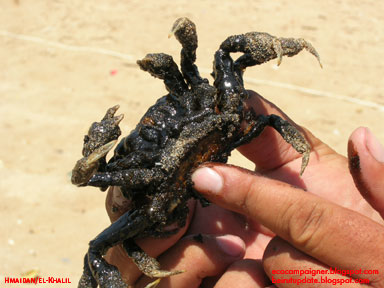
I got this from a Lebanese lady's blog- she is an artist living in the country at the moment and is sharing her everyday experiences. If you have time check out the rest of her blog:
'a crab eulogy'
by the way, we tried to wash the crab. tried to save it. but the oil wouldn't come off. it was so thick. we had to leave him on the beach. i want to take this moment to mourn all our sea life and animals that succumbed or will succumb to this senseless and unjust war. i apologize on behalf of mankind who can be really stupid sometimes. we invade your space, your habitats... we impose our way of life on you... we drag you into our mess... for this, i am so sorry. dearest Mother Nature, i hope you can find a way to forgive us. we still have so much to learn.
She also made a comment on Byblos, one of my favorite little cities in Lebanon. Below I have some pictures from when I was there with my family in December. The first one is from after the disaster:

Byblos (Jbeil) bay is completely smothered. this once picturesque and touristic town, also the oldest port city on Earth, is in ruins. we could smell the oil before we were anywhere close to the bay. this summer, the town was planning to celebrate its 7,000th birthday! there were huge festivities planned... so much went into it... now... nothing but this black plague. we stopped to speak with a few fishermen. they are completely devastated. they have no means of income anymore. so many of them had fixed up their boats for this summer i hopes of giving tourists small boat trips around the coast. now, that is gone too.


Subscribe to:
Posts (Atom)