Will we finally be able to say that about this worst massacre in U.S. history? Or will we have to wait for the next worse one to occur? It has been about a decade now since the Columbine shooting and there have been many others who have fallen victim to such type of crimes in our nation. Have we not had enough wake-up calls? Why has so little effort been put into trying to find a solution? We did quite well and reacted quickly enough to bring down a dictator and who was falsely accused of having Weapons of Mass Destruction as well as bring down his entire nation. Can't we instead focus a little more attention on our own nation's ills?
Just about an hour before I heard about the shooting at Virginia Tech, a friend of mine at work and I were talking about violence. She was asking how I could cope living in Lebanon with such violence and insecurity around me. I told her that although I did get a little frightened at times, it wasn't much less insecure than here in the US- it's just a different type of danger. There it's bombings for political reasons, usually targeting politicians and here it's random crimes- and you'll never know when you'll be the next victim. She had never really thought about it that way and started telling me how disgusted she was about the level of crime in this area. Next thing we know..... a gunman on Tech's campus!! I could not believe it! Many people from here go to that university and I had several friends graduate from there- thank God I know no one who has been directly affected by it.
I pray for all those who are affected by this horrible event. Especially for the parents of the gunman, who must be devastated to know that their son was responsible for such a crime which has caused pain in the hearts of so many people. I'm sure they came to this country in search of a better life not only for them but mainly for their children. Although I am deeply saddened by this I also am hopeful that it will motivate people to wake up a bit and do more to help solve this problem. Even if it's just a little contribution to improving the society in this country. Little steps at least lead you somewhere. After so many repeated incidents, I think it is time we find a cure to the illness. I feel as though we have been cultivating a culture of war, violence, and at times too much individuality and competition which causes people to feel lonely, secluded and stressed. I can't say those are the only reasons this happened, but I think they are contributing factors. It is a fact however, that the U.S. has the highest (or at least one of the highest) rate of depression in the world. And as we all know, depressed people can sometimes act in unpredictable ways.
Watching the list of students and professors that fell victim to this crime last night made me think about all those who have fallen victim to wars around the world- most notably the Iraq war. Can you imagine if each day since 2003 the media would dedicate a few seconds to every person (American and Iraqi) who died that day? Telling their age, comments from friends and loved ones about them etc? Can you imagine the stir it would have caused? I think we would maybe not even still be there right now. My point is that as we are shocked to hear about these deaths, let us not forget those who have to go through this everyday! As Bush said in his statements regarding this incident, schools should be a safe haven, a sanctuary- does that apply only to the US? Kids risk their lives all the time when they want to go to school in Iraq. Many stopped going all together. Many who have gone are now dead. I'm not in anyway trying to undermine what happened earlier during the week. I'm trying to note that what we feel today, all the sympathy, all the pain, all the questions asking 'why did this happen?' should be related to any such tragedy. Maybe we should take peace education a little more seriously. Maybe we should also think a little more about gun-control. Any thoughts?
Wednesday, April 18, 2007

Tuesday, April 17, 2007
Balata through children's eyes
Teaching kids in disadvantaged areas photography so they can document their lives? That's exactly what an American photographer named Matthew Cassel did when he travelled to a refugee camp in the West Bank called Balata. There are almost 25,000 residents living in Balata, which is less than one square kilometer large. To listen to an interview with Cassel which includes details on the creation of the project and background information on the children participants listen to: http://www.chicagopublicradio.org/Program_WV_Segment.aspx?segmentID=9984. You can also take a look at the kid's work on the photo galleries at: http://www.picturebalata.net/
The following is a short video taken from the website:
The following is a short video taken from the website:
Friday, April 13, 2007
Remembering the past in hopes of improving the future
Painful recollections, measured words define Civil War remembrance day
Victims, activists and students gather to discuss lessons of conflict
 "BEIRUT: Mona al-Ali was just 11 years old when she became one of the first victims of a war that was to last 15 years and claim thousands of lives. On April 13, 1975 - which would come to be remembered as the first day of Lebanon's Civil War - Ali was returning from the theater with her family. On the way back to their home, in the Beirut neighborhood of Barbir, masked gunmen opened fire on their car." Continue the article at.... http://www.dailystar.com.lb/article.asp?edition_id=1&categ_id=1&article_id=81426
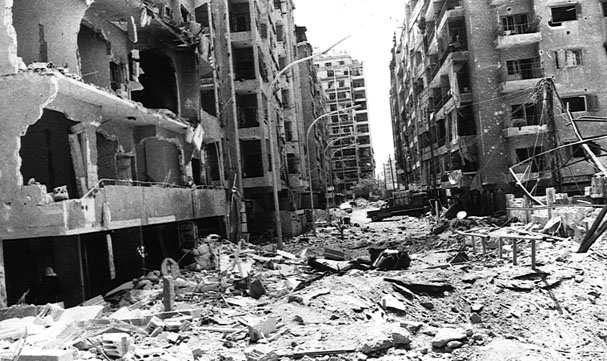
Will remembering the past really help prevent future repetitions of the same human catastrophes occuring another time? Who knows, but it can't hurt to keep in our mind how painful these experiences were as long as we can remember them without spite toward who was the enemy and instead move beyond this. Instead realize how it doesn't bring you any closer to your goal and only brings more misery. Now, over 30 years after the civil war in Lebanon, the country is again showing signs of sliding back into the same hell hole. Let hope that the slogan "Remember it, don't repeat it" will stick in the minds of the people. The coming generation is the first generation not to have experienced the war firsthand, this makes it a very delicate time to pull through because the young generation has nothing to compare to and instead can tend to glorify war especially when hatred is still present between different sects and further agitated by current political trends. Despite this, I have hope that part of the youth as well as those who did go through the war and realize the big mistake, are waking up and ready to make a change. It is important to support them and give them a chance for their voice to be heard- after all, that's what democracy is supposed to facilitate, right? I'm glad they had a ceremony for them to express themselves at such a crucial time.
*First picture from 'People's Daily Online' second one from 'country-data.com'
Victims, activists and students gather to discuss lessons of conflict
"BEIRUT: Mona al-Ali was just 11 years old when she became one of the first victims of a war that was to last 15 years and claim thousands of lives. On April 13, 1975 - which would come to be remembered as the first day of Lebanon's Civil War - Ali was returning from the theater with her family. On the way back to their home, in the Beirut neighborhood of Barbir, masked gunmen opened fire on their car." Continue the article at.... http://www.dailystar.com.lb/article.asp?edition_id=1&categ_id=1&article_id=81426Will remembering the past really help prevent future repetitions of the same human catastrophes occuring another time? Who knows, but it can't hurt to keep in our mind how painful these experiences were as long as we can remember them without spite toward who was the enemy and instead move beyond this. Instead realize how it doesn't bring you any closer to your goal and only brings more misery. Now, over 30 years after the civil war in Lebanon, the country is again showing signs of sliding back into the same hell hole. Let hope that the slogan "Remember it, don't repeat it" will stick in the minds of the people. The coming generation is the first generation not to have experienced the war firsthand, this makes it a very delicate time to pull through because the young generation has nothing to compare to and instead can tend to glorify war especially when hatred is still present between different sects and further agitated by current political trends. Despite this, I have hope that part of the youth as well as those who did go through the war and realize the big mistake, are waking up and ready to make a change. It is important to support them and give them a chance for their voice to be heard- after all, that's what democracy is supposed to facilitate, right? I'm glad they had a ceremony for them to express themselves at such a crucial time.
*First picture from 'People's Daily Online' second one from 'country-data.com'
Thursday, April 12, 2007
Planet of the Arabs

Here is a short (9 min) documentary on Hollywood's portrayal of Arabs and Muslims. It shows clips from various movies in the past century. I first saw this a few months back at a conference which spoke about Arab-Americans and this was to show us how dehumanized they have been through Hollywood movies. Apparently, out of 1000 films that have Arab & Muslim characters (from the year 1896 to 2000) 12 were postive depictions, 52 were even handed and the rest of the 938 were negative. Please feel free to share your views on the clip. This may also make you pay closer attention not only to the portrayal of Arabs, but also other ethnic minorities in main-stream media. It was a selection of the Sundance Film Festival 2005 and was based on a book by Jack Shaheen. Click: http://www.youtube.com/watch?v=-r49-9lMU9w
Wednesday, April 11, 2007
Scamming the Congolese: An environmental disaster in Congo

Despite the clear illegality of the situation, the village chiefs whose community depend heavily on the forests, are no match for the World Bank who has been blamed for not rectifying the deal. It is hard to imagine that after everything Africa has suffered at the hands of the "developed" world, it continues to be sucked of its riches. Several million of the poorest people in Africa depend on its forests according to the article: http://www.guardian.co.uk/congo/story/0,,2054203,00.html
Saying "No" to say "Yes"? Saying "Yes" to say "No"? Let's just say it's saying a 'positive-No'!
Here is a radio segment of an interview with William Ury, the author of "Getting to Yes." As a mediator and director of the Global Negotiation Project at Harvard University, he has written numerous books and dicusses here his latest one called "The Power of a Positive No: How to say NO and Still Get a YES."
http://www.wamu.org/programs/kn/07/03/08.php#13099
http://www.wamu.org/programs/kn/07/03/08.php#13099
Subscribe to:
Posts (Atom)