Monday, September 07, 2009

I was pleased to see this on my Skype this morning... heads up for the 21st of Sept.

It's not common to see these types of advertisements. Why? Well, we all know peace doesn't sell so well. Most people don't even realize that a Peace Day exists, so I was happy to see this little reminder on Skype!

Peace One Day

How about a peace year?? Hah!

Tuesday, July 21, 2009

Europe in 2020??


Could this be what we can expect western Europe to look like in the near future? Honestly, I'm rather skeptical.

Monday, May 11, 2009

Swine flu? Why is no one talking about Sri Lanka?

Almost 500 people have died up to now in Sri Lanka and no one seems to care as much as the pig flu that's been grasping the world's attention. Are we seeing a great manipulation of the masses by the media before our eyes. How many people have actually died from this silly swine flu? Less than 10, I think......

Wednesday, March 25, 2009

A Human or an Animal? An Animan!

What does it mean to be a human or part of the human race? What is humanity? Are humans animals? Where does one draw the line? What makes us distinct from the animal kingdom?


Often times when faced with the reality of violent human conflicts, one ends up concluding that humans are all animals. What does this mean? That we are savage, violent, void of emotion and compassion? I almost never see crude violence around me everyday in my immediate environment. So does this make only some humans more animal-like than others? What is the difference really? I think there needs to be another word invented for “our species”- something that is between a human and an animal. Maybe we can call ourselves Animanes?


Let me explain myself a little more. Most would generally agree that the main characteristic that distinguishes us from animals is our elevated capacity to use our brains. This implies our capacity to engage in the creative process to invent things, to find solutions to problems, to express intense emotions, to think profoundly and try to understand that which is beyond our current reality- the metaphysical or supernatural world. No other animal, besides the human (at least to our current knowledge) has been able to demonstrate similar characteristics to such a degree. So if humans are the only ones that have such major characteristics that differentiate them from the rest of the animal kingdom, why is it that we still fall in the animal category? We only refer to humans as animals once they tend to show their human side less. Obviously, humans are placed from one end of the “Humane/Animal” spectrum to the other. So why don’t we create another word in between? Something that defines us as animals but still capable of being human?


This can explain our capacity to change from one end to the other depending on our environment. This is our delicate and dangerous position as “intellectually advanced animals” capable of acting as savage animals however with the advantage of using our intellect to cause even greater damage. The creation of nuclear arms can be a prime example of this. I think if we were to create another name to describe “our kind” some of us would be more tempted to reach the category of ‘human’. It would be clearer to us that we have a choice to either be more animal-like to being more human-like. For now, we assume that humans are just animals- justifying our use for violence, our acts of greed, revenge and selfishness. We often ignore the fact that as humans we also have an immense capacity for compassion, emotional understanding, and support even under the most difficult situations. We can surpass these ugly “animal-like qualities” if we work hard enough to develop them.


It’s incredible how we can be capable of switching our minds completely. One minute you can be living life filled with love, compassion for others, interest in developing your life and your society. But then let’s say a war breaks out. Suddenly you are faced with constant violence around you, with divisions, categorizations and a threat to your survival. With no escape- it becomes nearly impossible to hold on to your humanity. I remember a conversation I had once with one of my friend’s aunts who lives in the south of Lebanon. She lived there through the civil war, through the several conflicts with Israel in the region, including the most recent confrontation they had with Hezbollah. She said “It doesn’t matter if you don’t want to be part of politics of the conflict- you have no choice! If you want to be neutral, people despise you for it and you are considered an enemy by all sides.” With this mentality, you are obliged to be part of the violent momentum around you. This is exactly how military groups are formed. Either you join or you die. Either you lose your humanity or you die. Most people choose to lose their humanity.


That’s how we end up many times with these vicious military commanders who perform unbelievably grotesque actions against humanity. These are humans who have been conditioned to appease to their savage animal side- making them capable of killing hundreds of people around them. I was reading a book written by Mia Ghoussoub (Leaving Beirut). She gave a very telling excerpt of an ex-war criminal’s testimony:

Hannah Arendt repeats a dialogue recorded by an American journalist in Nov. 1944

Q: Did you kill people in the camp?

A: Yes.

Q: Did you poison them with gas?

A: Yes.

Q: Did you bury them alive?

A: It sometimes happened.

Q: Were the victims picked from all over Europe?

A: I suppose so.

Q: Did you personally help kill people?

A: Absolutely not, I was only paymaster in the camp.

Q: What did you think of what was going on?

A: It was bad at first but we got used to it.

Q: Do you know the Russians will hang you?

A: (Bursting into tears) Why should they? What have I done?

That’s how we can become completely desensitized- completely disconnected with our humanity. Shortly after having read this passage I saw the Francis Bacon expo and found it interesting that one of the greatest themes in his art was his comparison of humans as animals. He believed that without God, man was susceptible to the same tendencies as animals. For this reason, he often made comparisons in his art to humans’ animal instinct. Above is his painting: "The Body, the Meat and the Spirit: Becoming Animal"

Monday, March 16, 2009

Cartoons in Semitic Lands

Was the uproar caused as a result of the posting from the Danish cartoonist portraying the Prophet Mohammad, have been more of a cultural thing? Indeed.

In the history of Semitic lands there is almost no tradition of using political cartoons to express opinions. Both the Jewish and Muslim traditions especially, use pictures sparingly and even more so when it comes to depicting any parts their religions. As we know, many aspects of what we (in the Western world) consider to be parts of daily life are considered in the East to be taboo. It is no wonder that the Danish cartoonist had to go in hiding after having severely offended an entire religion and cultural tradition. Sure, it shouldn't have been taken so seriously, and Muslims should have understood that cartoons are a very common form of expression in the West. But, can we expect that? Especially at a time when the religion already felt attacked by the entire world?People in the west have built a strong tolerance for criticism through cartoons- because everything and practically everyone is criticized at one point or another. But we can't expect another culture that is not used to this to take cartoons with a grain of salt. A cartoonist in the west wouldn't survive very long if he were "Mr. Nice Guy". He has to be witty, aggressive and ABOVE all, critical.

But traditions are changing a bit in the Semitic world. It is verrrry slowly starting to open up to using cartoons as a way to bring out social criticism. According to a BBC article, the British Council is hosting a tour in the Middle East of an exhibit of political cartoons, from cartoonist who are from the region mainly, in order to show the impact that they can have.

For now, the anarchist, Mr. Kurt Westergaard, who lacked a bit of cultural understanding has come out from hiding. Can we claim its a matter of freedom of speech, or is it a matter of respect for traditions? It will be interesting to see how the Middle East develops their tolerance to the slow introduction of more critical cartoons.

Tuesday, January 13, 2009

Mi región esta enferma

Mi región esta enferma,
necesita un medico, pero también los médicos parecen enfermos

Mi región esta enferma,
con un virus tan fuerte,
tan infeccioso y casi incurable

Mi región esta enferma,
de orgullo, egoísmo y
ningún respecto por el otro-
ningún respecto por la humanidad

Mi región esta enferma,
y por eso esta desfigurada.
Veo la muerte, la depresión,
la desesperación.
Veo
la injusticia y la estupidez-
cosas que matan a mi región.

Mi región esta enferma,
ayuda por favor!
Escuchad por favor, porque los médicos parecen muertos!

Mi región esta enferma,
lo veo claro, hay una gran diferencia
entre lo que era
y lo que es.
Era una maravilla,
con una historia- tan bella.
Ahora solo veo
un futuro feo.
Necesita un remedio:
esperanza, paz y entendimiento

Mi región esta enferma,
enferma de ella misma
enferma del miedo
enferma de la inseguridad.
Ayuda
por favor!
Escucha por favor, porque los médicos parecen muertos
y pronto me muero yo...

Saturday, January 10, 2009

Gaza: Why does it seem helpless?

What would holocaust victims think of the events going on in Gaza right now? I cannot imagine that they would condone them. I fail to understand how a people who preaches to the world not to forget and ever repeat the atrocities of the WWII Holocaust, commit the same acts on another people. How is this justified? The government keeps claiming to be protecting the country's security, but when you see death ratios like 500:11, you know there's something that's not right. When you actually look into the details of those being killed and it's mainly civilians on one end and on the other end over half of them are military, there's another clue of some injustice going on. And yet another clue? When your own citizens are telling you to STOP attacking the "enemy". When some refuse to fight and instead choose to go to prison because they realize the damage the military is doing to their country.

I was in Lebanon on vacation when the attacking began. Being in the region, it was clear to see that the biggest accomplishment the Israeli government has made for its country through these actions is create more hatred toward them. More passionate anger, more people willing to fight against them. They have essentially created more enemies (or what they label as terrorists) and thus further ensured their insecurity in the region.

What is their long term goal? Are they trying to completely annihilate the Palestinian population so they won't have to deal with the prospect of sharing the land any longer? Why is the international community not putting an end to this? How is collective punishment being tolerated by the biggest representatives of democracy? Just as culpable, if not more so, are the other Arab countries who do nothing to help stabilize the region and call for justice.

This siege on Gaza is all too familiar to the 2006 war in Lebanon.

According to the Edward Peck, the former chief of mission in Iraq and Mauritania and deputy director of the White House Task Force on Terrorism in the Reagan administration, "The U.S. has a legal definition of international terrorism: Title 18, U.S. Code, Section 2331. The list includes intimidating and coercing a civilian population, kidnapping and assassination, an accurate description of what Israel has done and is doing." Unfortunately, the international attitude toward this conflict is heavily biased and tends to ignore these actions conducted by the state. As a result, we have a frustrated population faced with using the only means they know how to defend themselves with: more violence. So who's to blame? Shouldn't the international community know that terrorism breeds more terrorism? Then why is there so much tolerance?

For the sake of innocent people on both ends of the conflict I hope- this carnage ends soon!

Wednesday, November 26, 2008

Your stuff

Do you know where all your stuff comes from? Where it goes? How it is produced? What actors are involved from the time of its preconception to its destruction?

I had a vague idea, but watching this documentary taught me quite a lot. Annie Leonard manages to creatively tell the story in this very entertaining and informative 20-minute video.

In The Story of Stuff, she has been able to transmit her message and call-to-action to millions of people in the hopes of bringing about some change to the current corrupt policies that are deteriorating our environmental conditions.

Wednesday, November 05, 2008

Thank you George Dubbya Bush!!!

Yesterday, November 4, 2008. Such a historic day would've never happened had we not had someone like George Dubbya Bush in office prior to the elections. The United States of America has elected a half-black man to be the President of the country! A man by the name of Barack Hussein Obama!!! Not a John Douglas, Peter Johnston nor a Henry Rogers, but a Barack HUSSEIN Obama. Something that without G. W. Bush's existence, would have at least waited many decades to occur.

To think that a country where racism was blatantly rampant less than 50 years ago has elected (what many just see as) a black president. A country where a large percentage of the population and/or their parents can remember the era of segregation- of the legal acceptance of racism have elected Obama. A half-black president with a Muslim name. The most recent "enemy" of the US. The Muslim Osama (obviously similar to the name Obama) who is culpable for the September 11th attacks on the US and the Muslim Hussein who was killed in Osama's place with a convenient manipulation of the truth.

Against all odds, Obama has still been able to pull through. With a population of Americans that are hungry for something different, hungry for some positivism in such a downward spiraling era. They have allowed the situation to get so bad and now shown the world that they are open to changing their image. Despite all the fear that was fed to voters to have them not choose a candidate who was "not American enough", or who was "a terrorist", or didn't have "enough executive experience"- whatever the propaganda was, it surprisingly didn't work this time. This doesn't mean there still isn't a race problem in the US- that is still a grave issue that needs to be addressed. However, it does represent that something different clicked with the American people this time.

Seeing this from Europe, we feel the big sigh of relief on this end too (or should I say 'especially'?). As was commented to me by a Spaniard not too long ago "The results of the US elections affects the entire world, we feel it too, and in some way we should participate in the elections as well". Now I don't see when that day will happen and I'm not so sure it should, but beyond that, why have we permitted only one country's election results to so heavily affect the rest of the world? Are we now approaching an era where we will no longer be speaking of just one superpower? Can we soon expect to have at least a few actors balancing each other out? Or will the US continue to be the world's dictator (as the US likes to so lightly use the term)?

So finally something decent has come out of all the embarrassment we have had to put up with. Now, all I fear is that our expectations are too high. Can the hopes that we have for the future be delivered? Will Obama truly be what he represents?

Monday, October 27, 2008

"Oops, I attacked the neighbor"

Wow, the US sure knows how to make enemies! As though it didn't have enough. It has committed its first illegal attack on Syrian grounds, 8 kilometers (about 5 miles) from the Iraqi border. There still hasn't been a decent explanation for the attack, but it is assumed that the US government has targeted the area for suspicion of an Al Qaeda connection. Syria has been accused of harboring "terrorists" and insurgents within its borders, but does this justify an illegal attack on civilians? After all, Syria isn't the only country suspected of harboring terrorists and it had been improving its relations with the US somewhat compared to other countries on the "black list". Syria was recently commended by US officials for strengthening efforts in diminishing the flow of foreign fighters. It has initiated plans for a peace deal with Israel and has recently made the big step of recognizing an international border with Lebanon.

Nevertheless, four US helicopters violated Syrian airspace as they flew into Abou Kamal on the eastern border of the country. Soldiers came out and attacked civilians in a construction site, killing eight people, including four children and severely injuring two others (who are not expected to survive). What has the US gained from this attack? Not sure, but at a time when they should be trying to make friends with their enemies it seems the Bush administration has decided to flex its muscles again instead. One last big show of might before they are to leave the office for good?

What implications does this hold for the coming administration? Whether its Obama or McCain who will lead next, they will now have to deal with a rather upset Syrian government. Could it be that Bush and his friends are a bit scared of Syria's recent diplomatic moves with its neighbors? The current administration just doesn't cease to disappoint me. Just more proof that they have completely thrown diplomacy out the window.


Sunday, October 12, 2008

Modern-day slavery, worse than ever

We're living in a high-tech world with no need for slavery anymore. Slavery is now a thing of the past, something we study about in our history books. Those dreadful days when humans were sold, used and treated as animals to perform physical labor are now a thing of the past. Today, this only MAY happen in remote parts of the world where they barely have any technological advances. Where they still have a "primitive" mentality. Humanity has generally learned from its past mistakes. We have learned from our history. We have apologized to each other and moved on to a path where slavery is no longer an issue..... or is it?

Unfortunately, I wish this were all true. Instead, we are living in an era where the rate of slavery is at its highest ever! Surprising, isn't it?

Human sex trafficking is now the largest form of slavery. It has become a major problem lately that has been overshadowed by other world problems such as the war in Iraq. Because of this is has been festering. Sex trafficking is not the only thing humans are enslaved for, there is also the example of small children being used as camel jockeys in the Middle East, those working in rich company's sweatshops, or laborers from neighboring countries working to build up Dubai and living in extremely poor conditions- just to name a few. All this adds up to what Professor Ethan Kapstein calls the "New Global Slave Trade". There have been a few pockets of people and organizations trying to eliminate this crime, but as most things go- when there are such huge profits being made somewhere, it becomes that much harder to wipe out the crime. It is now a big business and many of the world's governments seem to be condoning it.

Lately, celebrities have also started to become active . Call + Response is a new documentary that has come out addressing this issue. The title alludes to the African American 'call and response' that inspired slaves to pull through their suppression. The documentary is meant to use music again as a social movement to help liberate our modern day slaves. It is meant to be the "Call" that will receive a "Response" from its viewers. Below are links to a short history and a trailer of the documentary.


Trailer: http://www.youtube.com/watch?v=o-zaBMOdCoo

Saturday, October 11, 2008

And after a small lapse... I'm back

Yes, I've somehow not signed onto my blog in a couple months!!! Have I become a victim of the problem that I created my blog to prevent??? Unfortunately, I think I may have a little. I guess that just goes to show how easy it is.....

I have to admit that I have barely even dedicated half an hour a day to what's going on in the world. Since I have no TV at home, I don't get the quick fix of taking in the news thats fed to us either. Internet is my only outlet to the world, but I barely spend time doing personal work whenever I'm online. I sometimes go days without even responding to emails. I've become too occupied with my work and social life- Yes, that's everyones excuse, I know- pathetic. But I'm back!!! And I'm happy to be back. :-)

Sunday, July 13, 2008

Where the Hell is Matt?

Refreshing, clever and funny! Matt left his job to travel across the globe where he has shared his little dance and had others join him. As a result he compiled the shots taken in each location and made this short film. It's so simple yet quite moving!


For more go to: Stride link (has a video of cuts that didn't make it- its worth seeing); Official Website (includes journal of the places he has been to)

Monday, June 23, 2008

Tasting violence: "Buns and Guns"

Is this really so tasteful? I'm sure this would cut many people's appetite more than anything else. A restaurant in the southern suburb (Hezbollah strong-hold) of Beirut called "Buns and Guns" has recently opened up.

The motif? A military post.

Menu? In the shape of a bullet

The dishes served? Terrorist bread, Rocket-propelled granade, Kalashnikov, Dragunov, Viper, B52 etc.

Waiter outfit? Military uniforms

Acoustic? Digital sounds of military helicopters swooping overhead and rockets crashing

Their motto? "A sandwich can kill you"

Clever and humorous! The owner insists that his main goal was to make people laugh.... and we all know that good humor and creativity sells. That's just what the owner, Yousef Ibrahim is experiencing.

What are your thoughts on this? Does this just encourage and inspire pride for those who are using violence? Does it seem to ridicule the use of violence? Or do you think there really isn't any effect at all? Interestingly, they decided to put "terrorist bread" on the menu, thus labeling themselves as terrorists, a label that they fight against. Ibrahim states, "They accuse us of terrorism, so let's serve terrorist bread, why not?" This reminds me of Freedom Fries for some reason. Who knew food could get so political?!


Source: BBC

Sunday, April 13, 2008

West Bank Story: Shall we laugh it off?

"West Bank Story" is a 2007 Oscar-winning short film. If you haven't seen it maybe you can still share your opinions. Just to explain it a bit:

It is a parody of the musical "The West Side Story", where a young Palestinian girl and a young Israeli boy fall in love. They are each relatives of rival falafel restaurant owners, one called the Kosher Kings (Israeli) and the other called Hummus Hut (Palestinian). According to the director, who is of Israeli origin, it was meant to show how ridiculous the real situation is because in the end both sides share such similarities, yet they still live in hatred.

Is comic relief for such a serious conflict appropriate? Is it something that is lacking? Are people taking the conflict too seriously and just need to take a step back to look at it from a different angle as this short film suggests? Do you feel this over simplifies the conflict and gives an inaccurate portrayal of the real situation for those who aren't well informed of it? Please share your thoughts!

Here is the link to a news coverage of the film: Coverage
And a link to the official website:West Bank Story
(The film used to be available online but has been taken off for some reason.)

Wednesday, April 02, 2008

Les réfugiés de Cherbourg

The men aren't being drafted to Algeria in this story, instead men are fleeing from Iraq to find refuge in Europe. They are in fact known as "The ghosts of Cherbourg".

I was just in Cherbourg located on the coast of Normandy, France to visit my family for Spring break. As I was talking to my aunt in the kitchen, she pulled out a huge pot of soup and started telling me that it was for the Iraqis. "The Iraqis?!?!" I asked in shock, "What Iraqis?" She began to explain to me that there is a group of Iraqi refugees just hanging out at the ports looking for a chance to get to England by sneaking as stowaways on the ferries. My cousin and my aunt volunteer some of their time to go feed them whenever they can.

I was shocked by this. "So there is a group of refugees with nothing, just laying outside in the cold hoping for an opportunity to go to England and the government doesn't want to do anything about it?" I assumed that this has been going on since the beginning of the war, so how come it's still a problem that hasn't been dealt with? "And why England? Why not just try to settle in France?" "I don't know" my aunt commented, "they dream of going to England, to them it's much better than France!"

I ended up finding this article from The Guardian, explaining a little of the background of the situation. Turns out that the policies to stay in England are much more lenient than in France. As the number of refugees keeps increasing, many are not able to make it over and if they do they risk being sent back if caught. Tension is rising especially among the ferry owners and truck drivers (who load their trucks on the ferries) because they are the ones who suffer the consequences. They are responsible to pay a rather hefty fine for each stowaway that is found.

Is there really not a better way to deal with this situation? Under international law, they aren't allowed to be sent back to their country because it is at war. That's one step toward guaranteeing human rights, but what happened to the follow up? Are they really expected to be able to legally establish themselves wherever they end up if there are no laws to provide this luxury? This, to me, is just as much of a human rights violation. Some have died in the attempt of fleeing and there has even been a shooting at the port from angry locals toward refugees!

I still can't understand why nothing has been done about this serious problem. It's mind boggling to see how the effects of war can ripple to people and places that had never expected to be effected by it. Maybe this can open peoples mind to realize the fact that nothing in this world happens in isolation. A war in someone else's country is not something that should be shrugged off- it should be considered a problem for you too.

Monday, February 25, 2008

Transsexuals in Iran

Yes, it's legal to be a transsexual in Iran. Since being gay is seen as a medical problem, Iranian law has permitted gays to have sex changes. Clearly, homosexual relationships are strictly forbidden, but it has been justified (as the argument goes) to 'modify' one of God's creations.... just as you turn wheat into bread, you turn a male into a female and Voila!

Be Like Others is a recent documentary that came out this year, following the lives of a few transsexuals in Iran. The director, Tanaz Eshaghian, has won three awards so far for her film. The last screening was at the Berlin International Film Festival.

Sunday, February 17, 2008

Are we living in an 'Era of War'?

"According to the Stockholm International Peace Research Institute (SIPRI), the number of inter state wars is lower than it has ever been and the number of civil wars has been declining for at least fifteen years."
-Jonathan Power, "The Confidence to Say 'No' to Would-be Warmakers"


Despite all the reports you see on the news everyday, the world has not been having more wars than in the past. Now, there is also the consideration that we are now experiencing a new type of ‘warfare’- random terrorist attacks, but these don't kill nearly as many as when there is a full blown war. At the same time, however, our weapons today can cause much more destruction and result in the loss of many more lives than in the past. So does this mean that although we are having less wars, more people are dying? Most definitely.

Nevertheless, we should recognize the fact that (as the author in the article above points out) there has been a great accomplishment, to have a once-upon-a-time region of warring nations to stabilize. Europe! A great example to the rest of the world. Of course, it still has its issues (eg. separatists groups like ETA in Spain, and the past conflict in Ireland etc.), but we can be pretty sure that Germany and France won't go to war tomorrow. There is time now for the region to heal, to produce several generations who are aware enough of their past and at the same time experience a life of peace and stability. Something that many regions haven’t had the chance to experience for long enough. If you had told any European citizen 100 years ago that a European Union would be created in the near future, he/she would've laughed in your face and probably called you a lunatic.


So why has this progress in the history of humanity been greatly under-appreciated? Why has it not been seen as a stepping stone to further global unification? Or used as an example to other warring nations to help pull them out of their misery? Maybe because, as I have pointed out in several of my postings and as is mentioned in the above article, the realist view has permeated current politics and thus come to justify the high spending on security measures. Cause a sense of paranoia and nations will be more likely to stack up on arms.


Therefore, according to the study, our conundrum may not be that we are producing more conflicts, but rather that we aren't getting rid of the arms that are prolonging conflicts and as a result causing a rising number of casualties. The efforts to solve conflicts are being undermined by the fact that weapons are giving countries a false sense of security. As the advancement in arms technology becomes more sophisticated with biological, chemical and nuclear arms, the accessibility of them has not become any more difficult. That is the scary part. Now we are seeing the interplay between the different countries pointing fingers at each other. Each is playing their part in the blame game and in the meantime the arms collection keeps increasing. For what? Has the lesson not been learned yet?

So, for as much as I appreciate the tad bit of positive news that our current era is not necessarily one of increased warfare; I remain concerned with the prospect that our military power has increased its destructive potential and that practically no restrictive measurements have been put in place.

[Picture taken in Berlin]

Saturday, February 16, 2008

Be 'Pro-peace' not 'anti-war'

I have to admit that I have a bit of a problem with anti-war groups. They are usually a little too ‘anti’- if that makes any sense. It’s almost self-defeating… always against things, heavily criticizing the opposing view and eventually, stooping down to the same level as those they criticize. It just puts more hatred in the air. It polarizes more. It, to me, has a counter-effect.

Now, I think much of the work they do is important. I’m not saying that people shouldn’t be raising their voices when they see an injustice. Nor am I saying that I’m in favor of war. I can understand that those in the anti-war movement have much stored up anger since their views tend to be marginalized on the international stage. However, I propose that instead of gathering together to largely focus on criticizing the other- why don’t they get together to do a little less criticizing and a little more problem-solving. A little more dialoguing and brainstorming.

They should be the force that brings both sides to the table as a “pro-peace” movement, not “anti-war”. Many people can be for war. But, who’s going to be against peace? (That is, unless the peace that you want is exhibited as ‘anti-war’, THEN that may turn off those who don’t believe in a peace without war). If it can be framed in a way that it becomes an alternative to settling an argument or conflict, it can then become appealing to people in all playing fields. And the ‘anti-war’ movement can come closer to convincing the ‘pro-war’ movement that military means are maybe not the best way to resolve conflicts.

I bring this up because I was taking a look at bits of the “World Against War Conference” that was held back in December 2007 by the ‘Stop the War Coalition’ in London. It is nice to see that they were able to get so many well distinguished scholars to come together, as well as people who have taken part in peace processes, those who are directly suffering from the effects of war and basically those whose voices haven’t been heard much. For example, below is the video of a speech given by the ex-Chief Editor for Hezbollah’s Al Manar television station, Ibrahim Mousawi:

Now hearing him talk your reaction may either be, “well, he’s full of BS” or “hmmm, I didn’t know terrorists could be so reasonable after all”. Either way, it is a view that, the American audience especially, has not really been exposed to. Sure you’ll hear a lot of criticism geared toward so-called terrorist groups, but when do you actually hear comments from them firsthand? All the information we get is usually filtered or twisted truths. This makes it nearly impossible to provide us with any understanding of the other side. Or even to open up our minds to the possibility of favoring negotiations. Why do you think it was so easy for the Bush administration to have so much public support for going to war in Iraq after falsely connecting to it 9/11?? Did they stop to ask first what might be the reason that the attack occurred? Obviously not, otherwise people would’ve been quick to conclude that Iraq had nothing to do with it. I mean, if it was so easy for that to become accredited, what makes us think that the same strategies aren’t being used to demonize these “terrorists”?

Like Mousawi says, a terrorist for one person is a freedom fighter for someone else. Both sides are using violent means to defend their beliefs, so it makes them equally culpable. Using the current global conflict that we are experiencing, it goes like this: the US, Israel and most European nations consider themselves defenders of freedom, but they are considered terrorists to those who are generally labeled as terrorists. While the terrorists, as we know them, consider themselves freedom fighters… it’s a vicious circle that can keep going around and around and around, well, until a Savior comes along to tell us who’s right- only kidding…. but you get my point.

So I propose to get all these freedom-fighters together in the PRO-PEACE movement… anyone in?

Tuesday, February 12, 2008

Clash of what?!

For a second time now, Danish newspapers have printed the offensive caricatures of the prophet Mohammad. Is this a courageous gesture showing Muslims what great privilege the Christian-dominated West has to be free to express themselves? Or is this merely an act intending to mock Islamic beliefs and incite anger?

This case is thought to be a clear example of Samuel Huntington's theory of the "Clash of Civilizations". Below is a bit more debate on the topic coming from an Arab station.**

Reactions from the East:
Check out the responses to this video. Very interesting!

Part 1
Part 2
Part 3
Part 4

Extra

*The station, known as MEMRI (Middle East Media Research Institute) has been criticized for it's biased and propaganda-like coverage. Despite this, I have intentionally chosen to publish Wafa Sultan's video because it reflects what a majority of those who defend the theory believe.

Thursday, January 31, 2008

Technology Helping to Preserve a Primitive Culture


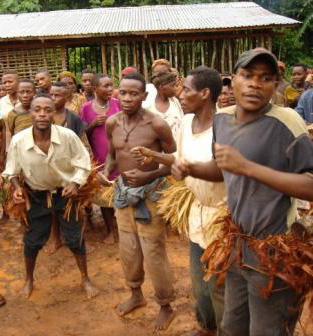
Baka Pygmies living in the forests of Africa have found a way to protect their territory against loggers using the GPS system! Check out this short video from BBC.


*N.B. Just to remain PC, by using the term "primitive", I am not intending to employ the connotation that it is a "crude" culture, but rather simple and not yet technologically advanced.

Wednesday, January 23, 2008

Holograms and Global Warming

In an effort to be more environmentally friendly, Prince Charles has showed up to a conference in form of a hologram, yup, you read that right.... a hologram.

The wombat's lesson

It's a very simple one.....


N.B. Found on http://peacerightnow.blogspot.com/

Friday, January 18, 2008

Stories from the south

Last weekend, I went to the south of Lebanon to visit my friends there. I was in Ghazieh one night to visit one of my friend's (ex-flatmates) moms and to spend the night. As we were sipping tea and chatting, the topic of the 2006 war obviously came up. The last time I had seen her was a few months before I had to evacuate and was never able to say goodbye.

Ghazieh was a town that was very affected by the war and in fact, one of Rime's good friends had her house bombarded and both her parents died [see entry]. Her mother's body, Rime's mom told me, was scattered everywhere in bits and pieces. Her father was burned, and her uncle- they never found a trace of him. They even tried to sift the dirt in the vicinity to find something, but only in vain. Can you imagine talking about your neighbors that way?

During the last few days of the war, the bombing got especially bad and Rime and her family had to escape. They ended up fleeing to the mountains in Chouf, with one of our common friend's family (another ex-flatmate). We didn't dwell on the topic of the 2006 war that much, Rime's mom didn't really want to talk about it, it was making her depressed. So she ended telling me with a smile, "Well, at least all the houses and buildings will be brand new!"

Later during the night I started to show her pictures on my laptop that I had taken at their place the last time I was there. One of the pictures I had taken was of one of her paintings that is hanging up in the living room, and in the corner there is a bullet-hole. Oh no, the negative topic came up again. She immediately recognized the picture, "Ah, yes! That's when the Israelis were here, that bullet-hole comes from them." (Rime had already told me that when I took the picture.) She told me it happened during the 1982 invasion. The Israelis came to the house and just start shooting randomly. She lifted her pant to show me the scar on her leg- she was shot that same day.
Several days after, her husband had forgotten the keys in the front door of the house and gone to take a nap. In came a group of Israeli soldiers and they started to look through all their belongings. "Where are your arms?" they asked the husband at gunpoint as he was lying in bed. He told them to get out, that they had no right barging into his house and accusing him. He had no arms. As I understood... that was the day they shot him and he nearly died, but luckily he was saved right on time in the hospital. This constant terrorizing continued until 2001, when the soldiers were pushed out... the next big bang wasn't to occur until the 2006 war.

Going to sleep that night, I kept having images in my head of being in an occupation. Of lying in the bed but just a few years back and knowing that at any moment the house could be attacked or invaded. Yeeewwww! I got chills!! How do people put up with the constant anxiety? Especially those who live even further down south- right next to the border- I just don't know how there are still people living there. It was time to get my mind off that... time to sleep.

The next morning we had breakfast with Rime who arrived from Beirut to spend the day at home with me. Outside the windows we could hear from the loud speakers of the mosques some chanting and preaching about the season of Achoura, one of the holiest holidays in the Shia'a calendar. The famous bloody processions in the streets are to be held in about a week (a few days after I am to leave Lebanon). I had already attended one the year I was living here, quite an experience [see entry - scroll down to Feb 8-9th].

At one point during breakfast, I thought I had heard a Cessna plane outside (ended up being a really loud motorcycle or something), which I thought was strange because you rarely see those flying around here. So I made a remark, "is that a plane I hear?!?" Rime and her mom started laughing, "No, they are afraid of us, they won't dare come again" Rime's mom told me. I wasn't thinking I heard a warplane, but since she brought it up, I went along with the stream of conversation. "Who are they going to attack? We are all Hezbollah. I am Hezbollah!" She said confidently. "I am Hezbollah" "No, you're not mom" Rime said, "you're not" - "Yes!" She insisted and repeated the same phrase in French and again in Arabic.

How can you tell a people who has experienced a direct threat to stay nonchalant about the situation. To not want to defend themselves somehow? Rime's mom is a school teacher. She teaches French along with chemistry and biology. All her life she has tried to educate the kids of her community and taken them on trips all around Lebanon so that they can get to know their country well. North, South, East, West, Central... she's seen it all, yet she has never left her country (except for a 4 day visit that she just made a couple weeks ago to Jordan). And this school teacher who has been promoting the French language for several years along with its culture; whose kids have all gone to college- one is a doctor in France, another an architect in the Gulf and Rime is finishing an advanced degree in speech therapy, yes, she is saying she feels as though she is part of Hezbollah. Can you blame her? Has she been given the chance to see other opportunities, other ways to feel secure?

This may be a strange analogy, but how do you think the people of New Mexico or Texas would react if Mexican soldiers started to occupy their lands because some group was attacking Mexico from the US. Lets say it was a group of Zapatista-type people who immigrated to the US and decided to get "justice" by attacking Mexico from the US border. So Mexico crosses borders illegally and terrorizes everyone living in the region for years. Let's say the US government is too preoccupied with Iraq and doesn't have enough military capacity nor time to handle the situation well. So the Mexicans stay there for a while since they are able to. Now, do you think that no grassroots group would eventually form on the American side in order to try to get the Mexicans out? People are already volunteering their time to control the border against illegal immigrants... they are willing to and in some scenarios have become violent just to control immigration of Mexicans to the US, who have not posed a violent threat. I believe the answer is pretty clear.

Now, at the same time, I don't think any group's reaction should be violent- but what are the odds that they won't be when faced with an aggression that is clearly stronger, is already oppressing a people and no one else is backing up your cause? Once these groups start to form however, there is always the risk of the leader turning into a power monger and almost brainwashing people to continue supporting him and closing their eyes to other avenues and/or solutions. Speaking of brainwashing.... when we were with Rime's aunt (her mom's sister), she started to talk about when the Israelis would call their home phone during the 2006 war. It was an automated message in Arabic that they would play to the residents where Hezbollah was present, trying to convince them that Hezbollah is bad, that they shouldn't follow them etc. etc. etc. They also threw papers down from planes telling them the same things. Interesting details of war...

Below are a few short videos and pictures taken by one of Rime's cousins in Nabatieh, a region south of Ghazieh.. The first video shows a cluster bomb going off. There are still several hundreds lying around everywhere and killing or injuring people. Yes, this is war:


The second video you can hear them trying to recognize the place and remembering which buildings were where.

The third video is of the sou2, or market, that was in Nabatieh.


Monday, December 31, 2007

I was offered to work for the devil

I generally don’t like to demonize things, but I can’t help to look at it that way. Let me explain. Yesterday, I went with one of my friends to her office in Beirut to check my email. She works for a Middle Eastern magazine called Defence 21. After I met her boss (who is a colonel in the Lebanese army) and told him in conversation that I was currently living in Madrid and looking for a job. He eventually offered for me to be a sales representative in Spain if I was interested, as a sort of part time job. I didn’t really know too much about the magazine yet, but glancing at the covers of the stacks of magazines in the office gave me a good enough impression that I would never ever work for such a place.

Having left the colonel politely telling him that I would “think about it”, I headed out of the office with a few past issues of the magazine and several copies of the Media Toolkit that he gave me. When I got home I took a look at what I had brought back with me. Page after page I saw the latest tanks, grenades, military airplanes, rockets, missiles and other war gear. I sensed anger and sadness as I flipped through the pages. Most of the magazine is in Arabic, so I couldn’t understand what was written, but the pictures were enough. The magazine claims to be one of the leading defense, security and aerospace magazines in the Middle East. The main recipients of the magazine are ministries of defense, defense procurement committees, general staff, military attaches, and service staff/units. The magazine is distributed to some 20 or so countries in the Middle Eastern and African region as well as other regions including Europe and the Americas. Those countries who receive the magazine the most include (in order): KSA (Saudi Arabia), Lebanon, Egypt, UAE, Jordan, and Algeria. It is also distributed in such current international hotspots as Iran, Syria, Pakistan and Sudan.

Why is military security portrayed as a need? Is it because we turned it into one? I realize that governments have to protect their countries, but do they really need to take it as far as is has gone and continues to go? Spending billions of dollars on military defense in the form of bombs and rockets?? Furthering the advancement of killing machines? With the amount of nuclear bombs out there, we have enough potential to completely destroy our planet. Looking at all the gadgets, I can just see all these warmongers delighting over them like little kids. “Ooooooo, look at that one!! It’s so powerful, we can destroy our enemy. We’ll scare them off and show them who’s stronger!! They’ll never dare to mess with us then!” It’s no longer a question of what’s moral and what’s not, but rather one of intimidating the enemy into submission to show who’s the boss. Imagine if they made a magazine featuring instead the effects that each of the war machines has on people: pictures of destroyed villages, dead babies, blood, pain, years of psychological damage. What would they think then? Or does that never even enter their minds?

There is word that political groups in Lebanon are currently arming themselves more. Do those working for this war industry in Lebanon really think that these groups won’t get their hands on these weapons and cause greater destabilization and destruction in their country? Or do they just not care as long as they have the money in their pockets? Unfortunately, I think the latter is the reality. You would think that these people who suffered from war directly would be wiser than that. Sure, they might see it as supplying their government with a means to help secure their country, but then again this is a bit naïve. After all the weapons are being supplied to a whole host of other nations who love to see Lebanon stay the way it is or get worse. I got a glance of what it feels like to be under the sophisticated armory of the Israeli military and let me tell you, it’s not so fun. I’m sure Israelis would tell you the same about Hezbollah’s arms. So why work for this? Why support this? Why be another being on earth putting energy toward more misery? Sadly, this is one of, if not THE most profitable industry in the world and when you’re in a country where the average salary per month is $400-500 I suppose you can sort of see why people would work for this. Many people, like my friend, would easily give in to this without thinking twice about the repercussions of their work. Let’s face it, there really isn’t much money in any organizations that promotes peace (besides maybe the UN, in which many would debate its ‘peacefulness’). Sadly, you practically have to volunteer your time if you want to work in such an organization. Why is this our reality? Why is it taking us so much time to change? Is there really no way to make the “peace industry” more appealing? I just refuse to think that there isn’t.

Thursday, December 06, 2007

Immigration scandals in my backyard

If any of you know Northern Virginia already, you know that it's a very diverse region. I grew up in Northern Virginia (NOVA, for short) and in my high school alone, there were several hundred languages spoken by the student body composed of approximately 1300 students. You could see everything from Vietnamese, Koreans, African-Americans, Cambodians, Palestinians, Somalians, El Salvadorians, Afghanistanis, Ethiopians, German-Americans, Indians, Bolivians, Pakistanis, Irish-Americans, and the list can go on and on. Naturally, due to geographic and historical reasons, Hispanic-Americans make up one of the largest ethnic minorities throughout the United States. As most of you know the rapidly growing number of immigrants has been causing much tension especially because a great number of them are illegal.

For this reason I find the controversy below a bit frightening. Especially knowing that it is going on right near my hometown. After all, isn't all this diversity what America is all about? Isn't it known to be a country made up of immigrants and that is what has helped make it so successful? Those who have been in the US longer than the new wave of immigrants are feeling threatened. But why is this so? The apprehension is a bit more understandable when coming from European countries, who have had a more enclosed history and haven't been receiving immigrants from far off countries for hundreds of years. However, what is this "patriotism" that is referred to? Because as far as I know, being a patriotic American doesn't mean that you hate your neighbor and resist immigration.

On the flip side, I can understand the frustration with many longstanding residents when they witness illegal immigrants not only staying in the country illegally for years, but on top of that acting irresponsibly (joining gangs, driving drunk etc). I don't think these problems can be eliminated by building a wall or spiting more venom at them though. One has to understand where these immigrants are coming from, what circumstances they left, and also recognize that a large percentage do not act this way. There must be a reason why so many are leaving their countries. Is this just the natural forces at work? In the end, their ancestors were the original inhabitants of what is now the USA. They were pushed out, still suffer from the effects hundreds of years later (were temporarily brought back by the US when it was in need of a helping hand building the infrastructure of the country, and expected to go back), and now with their successful neighbor next door, it's only natural that they would want a piece of the cake.

What are your reactions to what you see? What are ways you think we could quickly alleviate the escalating conflict? The video is actually in three-parts. You can find the other two parts along with reactions and more coverage of the issue at: http://www.youtube.com/9500Liberty